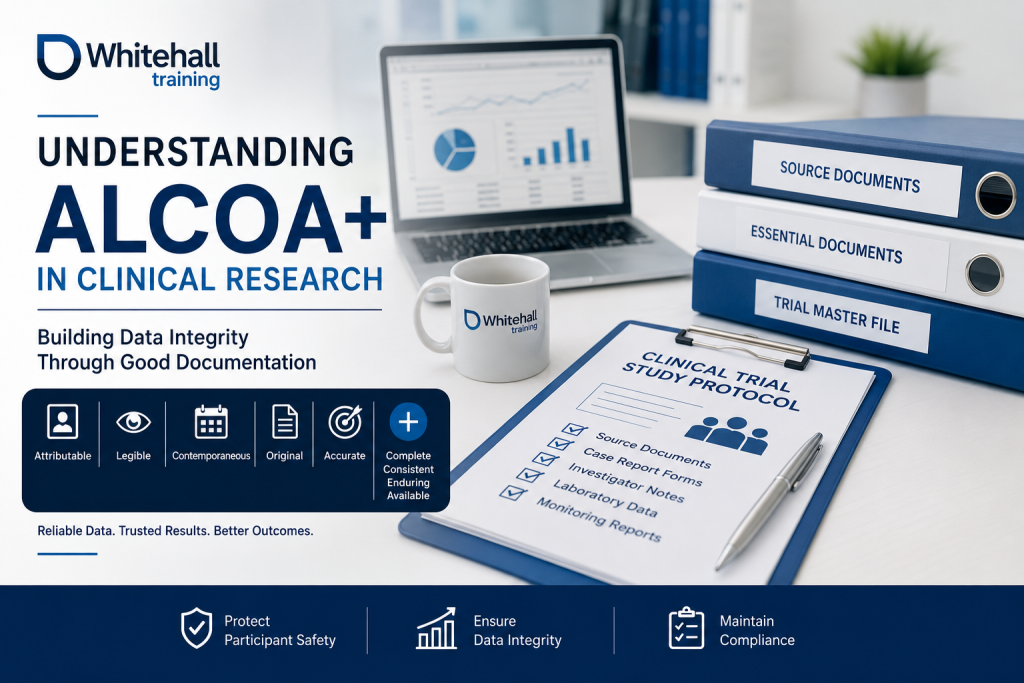
Clinical trials generate thousands of records throughout the study lifecycle, including informed consent forms, source documents, laboratory reports, electronic case report forms (eCRFs), monitoring reports, and regulatory documentation. These records form the evidence used to evaluate the safety, efficacy, and quality of investigational products.
The reliability of clinical trial outcomes depends not only on the data collected but also on the integrity of the documentation supporting it. Incomplete, inaccurate, or poorly maintained records can compromise participant safety, delay regulatory approvals, and result in inspection findings.
To help maintain high-quality data, regulatory authorities continue to emphasise the ALCOA+ principles, a globally recognised framework for ensuring data integrity in clinical research.
What is ALCOA+?
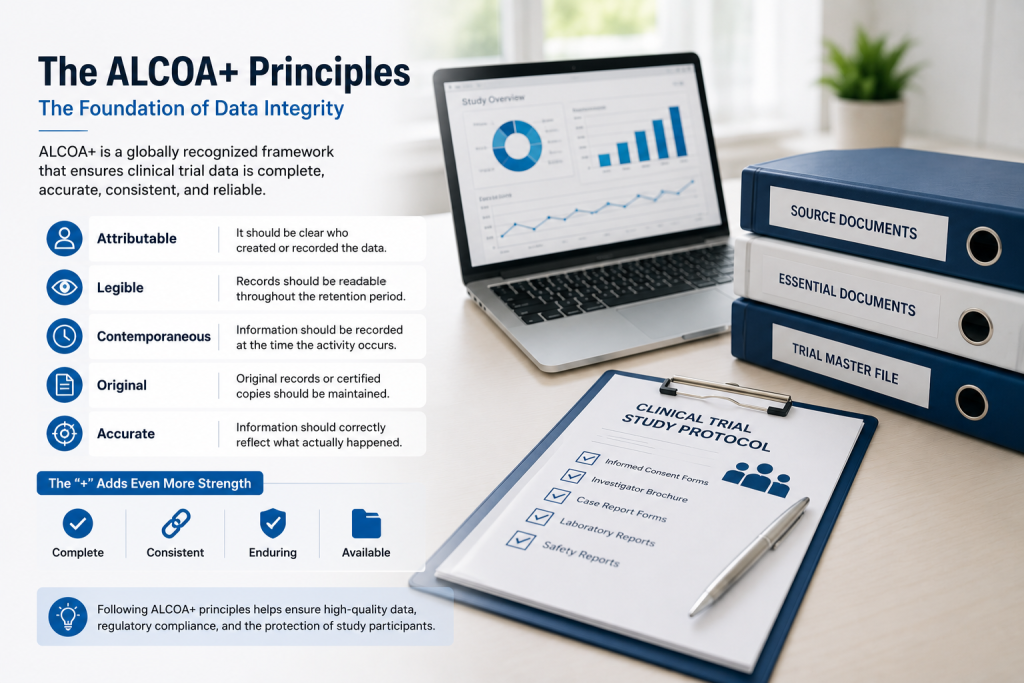
ALCOA+ is a framework that defines the characteristics of high-quality clinical research documentation.
Every clinical trial record should be:
Attributable – It should be clear who created or recorded the information.
Legible – Documentation should remain readable throughout the required retention period.
Contemporaneous – Information should be recorded at the time the activity occurs.
Original – Original records or certified copies should be maintained.
Accurate – Information should correctly reflect the activity performed.
The “+” extends these principles by ensuring records are also:
Complete
Consistent
Enduring
Available
Together, these principles help ensure clinical trial data remains reliable, traceable, and suitable for regulatory review.
Why is ALCOA+ Important?
Regulatory authorities rely on clinical trial data when evaluating the safety and effectiveness of investigational medicinal products.
The importance of ALCOA+ is reflected in several international regulatory guidelines.
These include:
ICH GCP E6(R3), which emphasises reliable documentation, quality management, and risk-based oversight throughout clinical trials.
FDA Guidance on Data Integrity, which highlights the importance of complete, accurate, and trustworthy records.
MHRA GxP Data Integrity Guidance, reinforcing expectations for maintaining reliable documentation across regulated activities.
EMA Good Clinical Practice expectations, supporting data quality and participant protection throughout the clinical trial lifecycle.
Although each authority uses different wording, they all share the same expectation: clinical trial data must be complete, accurate, traceable, and reliable.
ALCOA+ in Practice
Consider a routine monitoring visit conducted by a Clinical Research Associate (CRA).
During source data verification, the CRA identifies that a participant attended a scheduled follow-up visit outside the protocol-defined visit window. The visit has been entered into the eCRF, but the reason for the delay has not been documented in the participant’s source records.
To maintain compliance and data integrity, the CRA should:
Confirm why the visit occurred outside the permitted window.
Ensure the protocol deviation is documented appropriately.
Assess whether participant safety or study endpoints have been affected.
Verify that sponsor reporting procedures have been followed.
Confirm any corrective actions have been implemented by the study site.
Applying ALCOA+ principles throughout this process helps ensure the clinical trial remains inspection-ready while maintaining confidence in the study data.
Common Documentation Challenges
Some of the most frequently observed documentation issues during monitoring visits and regulatory inspections include:
Missing signatures or initials
Illegible handwritten entries
Backdated documentation
Incorrect correction methods
Missing source documentation
Inconsistent dates across study records
Poor documentation of protocol deviations
Many of these issues can be prevented through consistent application of ALCOA+ principles and ongoing Good Clinical Practice training.
Best Practices for Maintaining Data Integrity
Clinical research teams can strengthen documentation quality by:
Recording study activities immediately after they occur.
Following approved procedures for corrections and amendments.
Maintaining clear and traceable source documentation.
Reviewing documentation before monitoring visits.
Providing regular GCP and documentation training.
Encouraging continuous quality improvement across study teams.
Conclusion
High-quality clinical research depends on trustworthy data.
The ALCOA+ principles provide a practical framework for ensuring documentation remains complete, accurate, and inspection-ready throughout the clinical trial lifecycle.
By embedding these principles into everyday clinical research activities, organisations can strengthen regulatory compliance, improve data quality, and support better outcomes for both participants and sponsors.
Continue Your Professional Development
Develop a deeper understanding of Good Clinical Practice, protocol compliance, and clinical trial quality management through Whitehall Training’s professional courses:
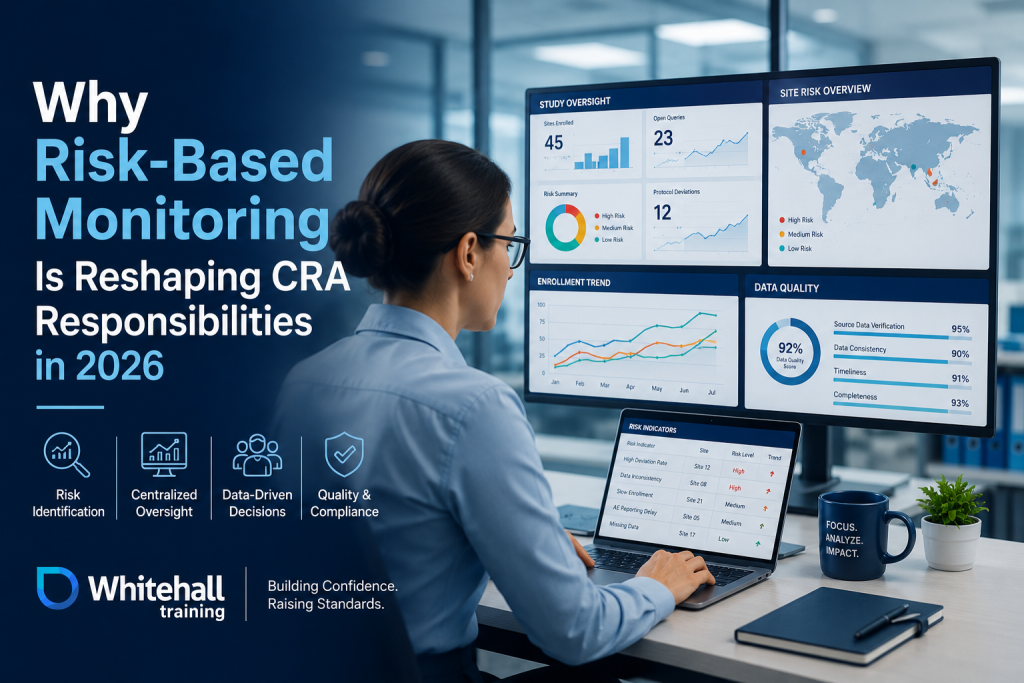
Clinical trial monitoring continues to evolve as sponsors and CROs increasingly adopt risk-based approaches to oversight.
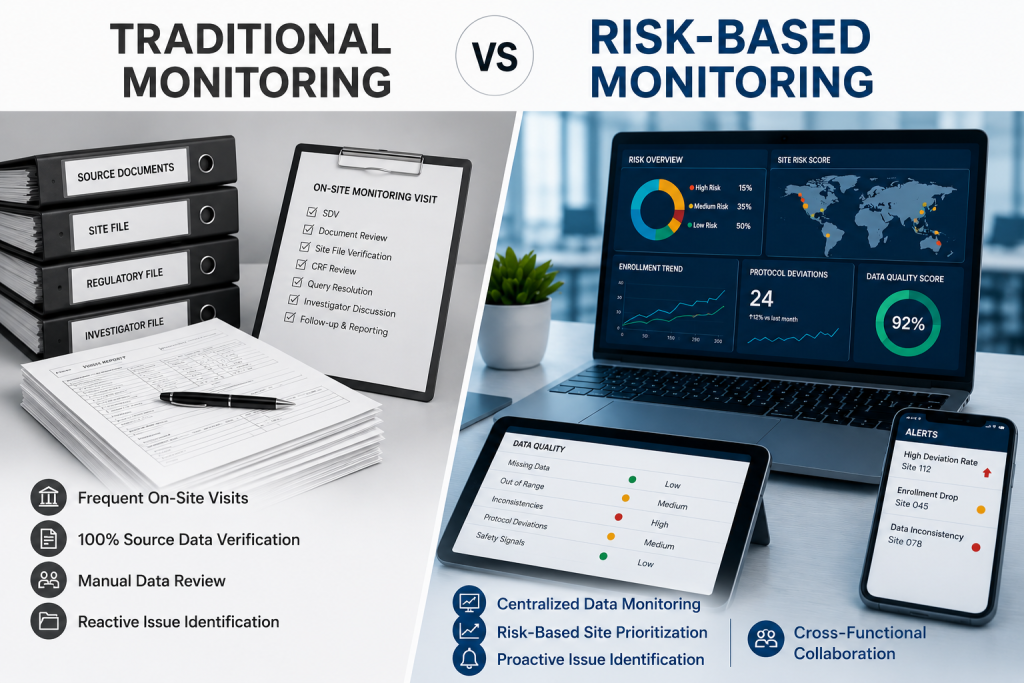
Traditional monitoring models that relied heavily on frequent on-site visits and 100% source data verification are gradually being replaced by more centralized, data-driven strategies.
As a result, the responsibilities of Clinical Research Associates (CRAs) are also changing.
In 2026, CRAs are expected to manage far more than routine site visits and documentation review. Modern clinical trials now require stronger analytical oversight, technology awareness, remote collaboration, and risk-based decision-making.
The Shift Toward Risk-Based Monitoring
Risk-Based Monitoring (RBM) was introduced to improve trial efficiency while maintaining patient safety and data integrity.
Rather than applying equal monitoring intensity across all sites and data points, RBM focuses oversight on areas that present the highest operational or clinical risk.
This includes:
critical data points
patient safety indicators
protocol deviation trends
site performance metrics
enrollment abnormalities
centralized data review findings
The increasing use of RBM reflects the growing complexity of decentralized and technology-enabled clinical trials.
How CRA Responsibilities Are Changing
Under traditional monitoring models, CRA responsibilities focused heavily on:
routine site visits
source document verification
regulatory document review
investigator site file checks
query resolution
While these activities remain important, RBM has expanded the role significantly.
Modern CRA responsibilities increasingly include:
remote oversight activities
centralized data review collaboration
trend identification
site risk assessment
vendor coordination
technology platform oversight
risk escalation management
CRAs are now expected to interpret operational signals rather than simply review documentation.
Increased Reliance on Centralized Monitoring
Many sponsors now combine on-site monitoring with centralized monitoring teams that review:
real-time study data
protocol deviation patterns
missing data trends
unusual enrollment activity
electronic system alerts
This model allows organizations to identify issues earlier and prioritize monitoring resources more effectively.
As a result, CRAs increasingly work alongside:
centralized monitoring teams
data managers
quality specialists
risk management personnel
decentralized trial vendors
Cross-functional collaboration has become a critical part of modern monitoring operations.
The Impact of Decentralized Clinical Trials
The expansion of decentralized clinical trial models has accelerated the adoption of RBM strategies.
Remote visits, wearable technologies, electronic consent platforms, and home healthcare providers create new oversight challenges that cannot always be managed through traditional monitoring methods alone.
Modern clinical research environments rely heavily on:
electronic data capture systems
risk dashboards
remote monitoring tools
cloud-based trial platforms
AI-assisted analytics
digital quality management systems
As monitoring models evolve, CRAs are expected to become more comfortable interpreting centralized data outputs and technology-generated risk indicators.
Operational understanding of digital trial infrastructure is becoming increasingly valuable.
Operational Challenges Associated With RBM
Although RBM offers efficiency advantages, implementation also introduces operational complexity.
Organizations may face challenges involving:
inconsistent risk assessment approaches
communication gaps between centralized and field teams
technology integration limitations
vendor coordination difficulties
staff adaptation to new monitoring models
For CRAs, balancing remote oversight with effective site relationships remains an ongoing challenge.
Regulatory Expectations Continue To Evolve
Global regulatory agencies increasingly support risk-based approaches when supported by appropriate quality management systems and documented oversight strategies.
However, regulators still expect sponsors and CROs to demonstrate:
adequate trial oversight
data reliability
patient protection
effective issue escalation
documented risk management processes
RBM does not reduce compliance expectations. Instead, it changes how oversight is applied.
The Future of CRA Roles
The CRA role is not disappearing.
Instead, it is becoming more analytical, technology-focused, and operationally strategic.
Future CRA responsibilities will likely place greater emphasis on:
data interpretation
proactive risk identification
centralized oversight collaboration
decentralized trial management
quality-focused decision-making
Professionals who adapt to evolving monitoring models may become increasingly valuable in modern clinical trial operations.
Related Learning
Whitehall Training offers clinical research and GCP learning solutions designed to support professionals adapting to modern monitoring and oversight expectations.
Risk-Based Monitoring is continuing to reshape clinical trial oversight across the industry.
As decentralized trials, digital systems, and centralized monitoring strategies expand, CRA responsibilities are evolving beyond traditional site monitoring activities.
Organizations that successfully combine risk-based oversight, technology integration, and operational collaboration will be better positioned to maintain trial quality, compliance, and efficiency in the evolving clinical research landscape.
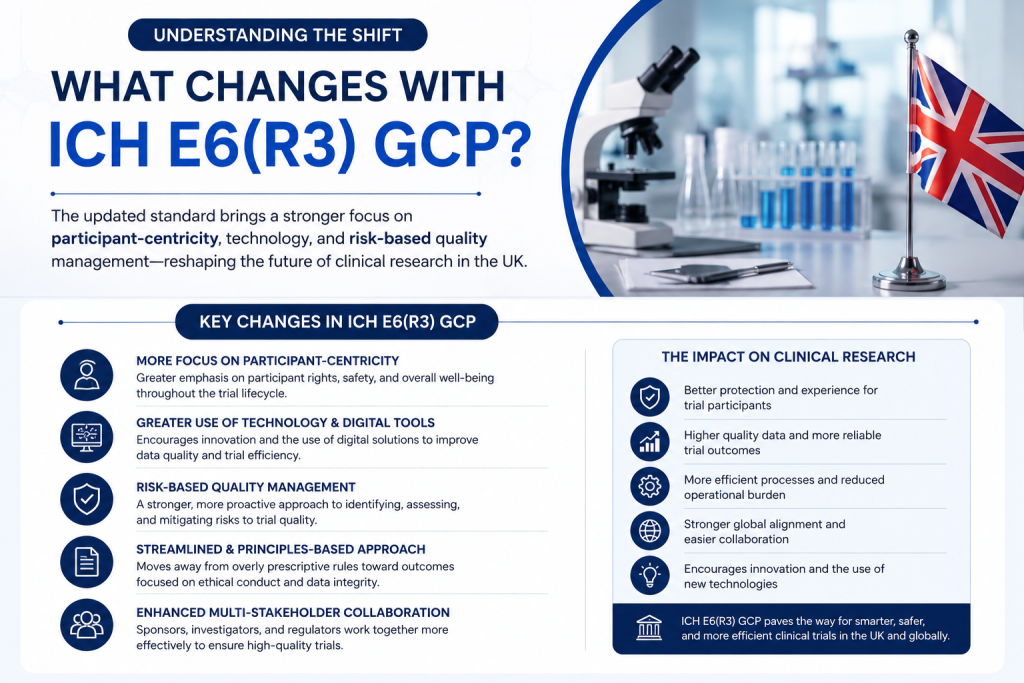
The adoption of ICH E6(R3) represents an important shift in the evolution of Good Clinical Practice (GCP). The updated guideline reflects the growing complexity of modern clinical trials, including decentralized models, digital technologies, risk-based approaches, and increased data integration.
As the UK aligns with the revised framework, organizations are evaluating how operational processes, quality systems, and oversight models must adapt to remain compliant.
Why ICH E6(R3) Matters
ICH E6(R3) modernizes traditional GCP expectations by placing greater emphasis on:
risk proportionality
quality by design
technology-enabled trials
data governance
vendor oversight
patient-focused trial design
The revised framework recognizes that modern clinical trials increasingly rely on digital systems, remote processes, and third-party service providers.
A Shift From Process-Driven to Risk-Based Oversight
Earlier GCP approaches often focused heavily on standardized procedural compliance.
ICH E6(R3) places greater emphasis on identifying critical-to-quality factors and applying proportionate oversight based on study risks.
This shift encourages organizations to:
focus resources on high-risk areas
strengthen proactive quality management
improve centralized oversight
integrate risk-based decision-making into trial operations
Technology and Digital Trial Considerations
Modern clinical trials increasingly depend on:
electronic systems
remote monitoring
wearable technologies
cloud-based platforms
decentralized workflows
ICH E6(R3) highlights the importance of ensuring these technologies are appropriately validated, monitored, and controlled throughout the study lifecycle.
Organizations must demonstrate that digital systems maintain:
data integrity
security
traceability
reliability
regulatory compliance
Vendor and Service Provider Oversight
As clinical trial outsourcing continues to expand, sponsor oversight responsibilities remain a major regulatory focus.
ICH E6(R3) reinforces the importance of:
vendor qualification
documented responsibilities
ongoing oversight
quality management controls
communication processes
Sponsors remain ultimately responsible for trial quality, even when operational activities are delegated to external providers.
Operational Challenges for Organizations
Adopting ICH E6(R3) may require organizations to review:
SOP frameworks
monitoring strategies
quality systems
technology validation approaches
training programs
risk management processes
Cross-functional alignment between clinical operations, quality assurance, data management, and regulatory teams will become increasingly important.
The Importance of Training and Readiness
Successful implementation of ICH E6(R3) depends not only on updated procedures, but also on workforce readiness.
Clinical research professionals must understand how revised GCP expectations apply to:
remote trial activities
risk-based monitoring
digital technologies
vendor oversight
quality management systems
Ongoing education and practical implementation planning will play a key role in supporting compliance.
Related Learning
Whitehall Training offers learning solutions designed to support organizations and professionals preparing for ICH E6(R3) implementation.
The UK’s adoption of ICH E6(R3) reflects the continued modernization of clinical research practices and oversight expectations.
Organizations that strengthen risk-based quality management, technology governance, and operational readiness will be better positioned to maintain compliance in an increasingly digital and decentralized clinical trial environment.
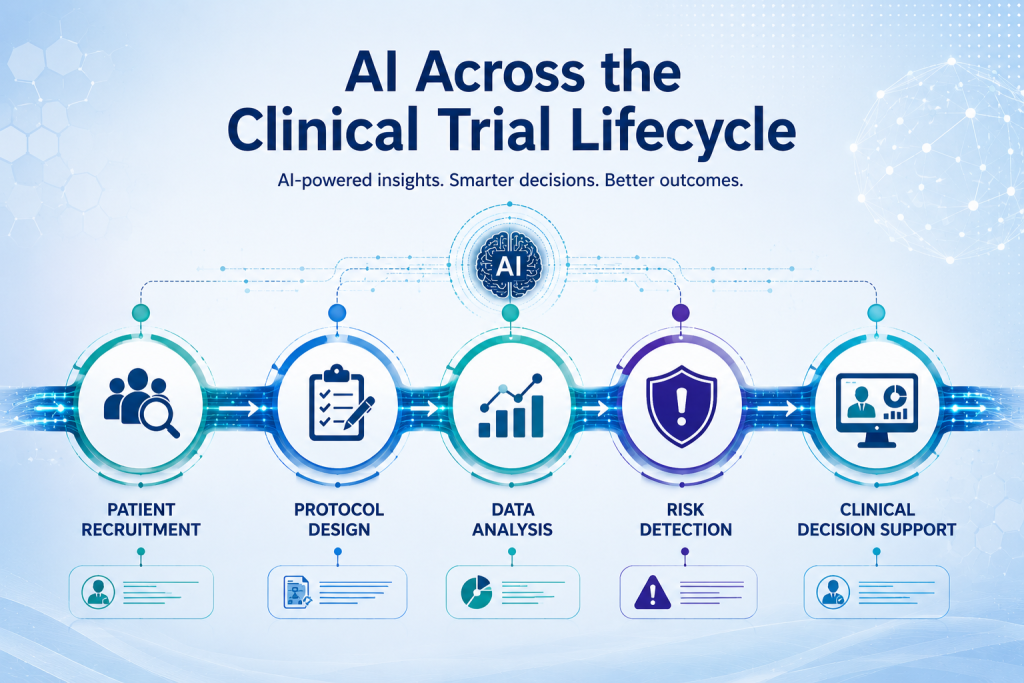
Artificial Intelligence (AI) is no longer a futuristic concept in clinical research. From patient recruitment and protocol design to data analysis and risk detection, AI is increasingly being integrated into various stages of the clinical trial lifecycle.
As clinical research continues to evolve, AI has the potential to improve efficiency, enhance decision-making, and support the development of new therapies. However, its growing use also raises important questions regarding oversight, data quality, and regulatory expectations.
Why Is AI Gaining Attention in Clinical Research?
Clinical trials generate vast amounts of data and involve numerous complex processes. Managing this information efficiently while maintaining quality and compliance remains a significant challenge.
AI technologies can help researchers analyse large datasets, identify patterns, support faster decision-making, and improve operational efficiency. As a result, many organisations are exploring how AI can complement traditional clinical research activities and help accelerate innovation.
Where Is AI Being Used Today?
AI is already supporting several areas of clinical research.
Patient Recruitment
Identifying suitable participants is often one of the most time-consuming aspects of a clinical trial. AI can assist by analysing healthcare records and matching patients to study eligibility criteria more efficiently.
Protocol Design
AI-powered tools can help researchers evaluate study designs, identify potential operational challenges, and optimise protocol development before trial initiation.
Data Analysis
Clinical trials generate large volumes of data. AI can support faster analysis by identifying patterns, trends, and anomalies that may require further investigation.
Risk Detection
AI-driven systems can help identify unusual data patterns and potential risks, supporting quality management and oversight activities throughout the study lifecycle.
Potential Benefits of AI in Clinical Research
The growing interest in AI is driven by several potential advantages:
Improved operational efficiency
Faster data processing and analysis
Enhanced patient recruitment strategies
Better identification of risks and trends
Support for evidence-based decision-making
Reduced administrative burden on research teams
While AI is unlikely to replace clinical research professionals, it has the potential to help them work more effectively and focus on higher-value activities.
Challenges and Considerations
Despite its potential, AI also presents important challenges that organisations must address.
Key considerations include:
Data quality and reliability
Transparency of AI-generated outputs
Regulatory expectations and compliance
Patient privacy and data protection
Human oversight and accountability
Ensuring the responsible use of AI remains essential for maintaining trust, quality, and integrity within clinical research.
Will AI Replace Clinical Research Professionals?
One of the most common questions surrounding AI is whether it will replace human expertise in clinical research.
While AI can automate certain tasks and assist with data processing, clinical research relies heavily on scientific judgement, ethical decision-making, regulatory compliance, and human oversight. These responsibilities cannot be fully delegated to technology.
Rather than replacing professionals, AI is more likely to become a tool that supports researchers, helping them make better-informed decisions and work more efficiently.
Conclusion
Artificial Intelligence is becoming an increasingly important part of modern clinical research. Its ability to support patient recruitment, protocol design, data analysis, and risk detection presents exciting opportunities for the industry.
However, successful implementation will depend on balancing innovation with appropriate oversight, regulatory compliance, and human expertise.
As AI technologies continue to evolve, understanding their role and limitations will be essential for clinical research professionals seeking to navigate the future of the industry. Developing AI-related knowledge and skills can help professionals remain prepared for emerging trends and evolving industry expectations.
Explore AI Training Opportunities
As AI continues to influence healthcare, pharmaceuticals, and clinical research, professionals may benefit from developing a deeper understanding of AI applications, governance, and implementation.
Whitehall Training offers specialised learning opportunities including:
Introducing Whitehall Training’s New Comprehensive Learning Paths
In an industry where regulations evolve as fast as the science itself, staying ahead isn’t just an advantage—it’s a necessity. Whether you are navigating the complexities of Pharmacovigilance, mastering Clinical Research, or ensuring GxP compliance, the depth of your expertise defines your impact.
At Whitehall Training, we’ve spent years helping professionals stay compliant and competent. Today, we are thrilled to announce a significant evolution in how we help you learn: The Launch of our Specialized Learning Paths.
Instead of piecing together individual modules, these paths offer a structured, curated journey through a specific domain, ensuring you gain a 360-degree understanding of your field while saving significantly on tuition.
Explore Our 5 New Learning Paths
We have bundled our most high-demand courses into five distinct tracks designed to take you from foundational knowledge to advanced mastery.
1. Pharmacovigilance (GVP) Mastery
The definitive track for drug safety professionals.
What’s Included: Drug Safety, Global Regulations, PV Audit, Signalling & Risk Assessment, and Device Safety & Vigilance.
Investment:£299 ~~(Original Price: £395)~~
Best for: PV Officers, Drug Safety Associates, and Regulatory Affairs specialists.
2. Clinical Research Associate (CRA) Excellence
Modernize your monitoring skills with a focus on documentation and technology.
What’s Included: CRA Essentials, GCP Refresher, Fundamentals of Clinical Trials, HIPAA, GDocP, and a dedicated AI module.
Investment:£229 ~~(Original Price: £265)~~
Best for: Aspiring and practicing CRAs looking to integrate AI and data integrity into their workflow.
3. Distribution & Manufacturing (GDP/GMP)
Ensuring quality and compliance across the supply chain.
What’s Included: GDP, GDP for Drivers, Quality Management Systems (QMS), and GMP.
Investment:£229 ~~(Original Price: £286)~~
Best for: Supply chain managers, logistics coordinators, and quality assurance teams.
4. The Ultimate GxP Bundle
A comprehensive “all-in-one” for total regulatory literacy.
What’s Included: GCP R3 (the latest standard), GCLP, GMP Annex 13, GLP, and GDP.
Investment:£299 ~~(Original Price: £405)~~
Best for: Quality Managers and consultants who need a bird’s-eye view of all laboratory, clinical, and manufacturing practices.
5. Clinical Trials (GCP) + AI in Healthcare
Future-proof your career at the intersection of ethics and innovation.
What’s Included: GCP R3, Fundamentals in Clinical Trials, and AI in Healthcare.
Investment:£149 ~~(Original Price: £285)~~
Best for: Clinical researchers and healthcare tech professionals looking to lead the digital transformation.
Why Choose a Whitehall Learning Path?
“The shift toward AI and updated GCP R3 guidelines means that yesterday’s training isn’t enough for tomorrow’s challenges.”
By choosing a Learning Path, you aren’t just taking a course; you are:
Ensuring Full Compliance: We’ve mapped these courses to meet the most current global standards.
Saving Time: No more searching for disparate modules; we’ve laid out the most logical progression for you.
Maximizing Budget: Save up to £136 compared to purchasing courses individually.
Ready to Start Your Next Chapter?
These paths are now live on our platform. Whether you are looking to upskill your team or accelerate your own career, there has never been a better time to invest in your professional development.
Introduction: The ‘Renovation’ Meets Legislative Reality
The clinical research community has long navigated the “GCP Renovation,” a strategic modernization effort initiated in 2017 to address the escalating complexity of clinical trial designs and the digital ecosystem. With the formal adoption of ICH E6(R3) on 06 January 2025, the industry moved from high-level reflection papers to a concrete, albeit highly flexible, international standard. However, for those operating within the United Kingdom, this is not a simple “copy-paste” exercise of a global text. Instead, it represents a sophisticated intersection where international harmonization meets the specificities of the UK’s legislative framework, overseen by the Medicines and Healthcare products Regulatory Agency (MHRA) and the Health Research Authority (HRA).As a clinical regulatory consultant, I often see sponsors struggle with the “translation gap”—the space between global principles and local statutory enforcement. The R3 update is designed to be “media neutral” and “proportional,” but in the UK, these concepts must be reconciled with the Medicines for Human Use (Clinical Trials) Regulations 2004, which were notably amended in 2025. Navigating this landscape requires moving beyond rigid, one-size-fits-all checklists toward a culture of “Quality by Design” (QbD). This shift demands that we stop treating GCP as a burden to be managed and start treating it as a strategic framework for trial efficiency.
The Status of ICH E6(R3) in the UK
While ICH E6(R3) provides the harmonized global framework for trials intended for regulatory submission, its legal standing in the UK is governed by statute. In the UK, all clinical trials of Investigational Medicinal Products (IMPs) must be conducted according to Good Clinical Practice as set out in the 2004 Regulations (as amended). Crucially, the UK annotations clarify that these principles apply to all IMP trials, regardless of whether the data is intended for a Marketing Authorisation Application (MAA).From a strategic standpoint, sponsors must understand the nuances of delegation. While the UK utilizes a streamlined application process, the legal accountability remains fixed.Per Regulation 16(1), the UK mandates a single application dossier—the “request for approval”—covering both the MHRA licensing authority and the HRA ethics committee opinion. Under Regulation 3(12), while a sponsor may delegate the function of making this application (e.g., to a CRO), such an arrangement does not affect the ultimate responsibility of the sponsor. Strategic oversight is not just a GCP principle; it is a statutory requirement that cannot be contracted away.
Takeaway 1: The End of “Error-Free” Data Perfectionism
One of the most impactful shifts in the R3 update is found in Principle 6 and Principle 7, which redefine quality as “Fitness for Purpose.” The guideline moves away from the traditional, and often prohibitively expensive, pursuit of “perfect” data. It introduces a reality where data does not need to be error-free if it supports conclusions and interpretations equivalent to those derived from error-free data.This is a profound change for Clinical Quality Management. For years, monitoring budgets have been consumed by intensive Source Data Verification (SDV) of non-critical fields. By focusing on “Critical to Quality” (CtQ) factors, sponsors can reallocate resources from administrative data-cleaning to proactive risk management. This proactive stance is the heart of Quality by Design.”Quality by design should be implemented to identify the factors (i.e., data and processes) that are critical to ensuring trial quality and the risks that threaten the integrity of those factors and ultimately the reliability of the trial results.” (ICH E6(R3) Section II)By identifying these factors prospectively, trialists can implement mitigation strategies that focus on what truly impacts participant safety and result reliability. If a data point does not influence the primary endpoint or a safety signal, R3 suggests we should treat it with proportionate oversight, not obsessive perfectionism.
Takeaway 2: The UK’s Counter-Intuitive Stance on Periodic IRB Review
A significant point of divergence for international sponsors is the UK’s interpretation of Principle 3.2. While the ICH text suggests that “periodic review of the trial by the IRB/IEC should also be conducted,” the UK-specific annotations provide a critical clarification.In the UK, there is no legal requirement for an Ethics Committee to undertake periodic reviews of a clinical trial once it has been approved. For sponsors used to the administrative cycle of annual renewals in other regions, this is a major “surprising” reality. However, this does not imply a lack of oversight. The HRA remains engaged through:
Substantial modifications to the trial (Regulations 22-22C).
Urgent safety measures (Regulation 30).
Serious breaches (Regulation 29A).
Annual safety reports (Regulation 35).This approach reduces administrative “busy work” while ensuring that the Ethics Committee focuses on high-impact changes and safety data rather than routine calendar-based renewals.
Takeaway 3: The “Delegation Log Diet” – Trimming Routine Care
ICH E6(R3) Annex 1 (Sections 2.3.3 and 3.6) introduces much-needed flexibility regarding the documentation of trial activities. The UK interpretation of these sections provides a strategic opportunity to “diet” the delegation log.The MHRA has clarified that individuals performing trial activities as part of routine clinical care do not necessarily need to be listed on the delegation log. Furthermore, Section 2.3.2 specifies that trial-specific training—including formal GCP training—should only be required for activities that go beyond an individual’s usual training and experience .From a consultant’s perspective, this is a call to action. We have seen “bloated” delegation logs where every nurse on a ward is listed because they might take a blood sample. If that nurse is taking a sample exactly as they would for any other patient, R3 and the UK annotations suggest they should be excluded from the log.Maintaining a 50-person delegation log for a simple trial creates an unnecessary maintenance burden and, ironically, obscures oversight. When an investigator signs off on a massive list of routine staff, they dilute their ability to demonstrate meaningful oversight of the staff performing critical trial-specific procedures. The “Diet” is about clarity, not just reduction.
Takeaway 4: A Decisive Break from SUSAR “Inbox Spam”
Safety reporting undergoes a strategic overhaul in R3 (Section 3.13.2). Historically, investigators were inundated with individual Suspected Unexpected Serious Adverse Reactions (SUSARs) from around the globe, often leading to “inbox spam” that obscured genuine local safety signals.The UK environment has moved decisively to streamline this:
Direct Reporting: There is no legal requirement to report individual SUSARs to investigators or Ethics Committees; they are reported directly to the MHRA.
Urgency Over Arbitrary Timelines: The strict 7/15-day timeline for notifying investigators and IRBs has been replaced. Section 3.13.2(d) now requires reporting to reflect the “urgency of action required.”
Alternative Arrangements: Section 3.13.2(f) introduces the possibility of “alternative arrangements” for safety reporting, such as selective safety reporting in late-stage trials (referencing ICH E19).This allows sponsors to move away from individual reports and toward aggregated safety information, providing investigators with a meaningful assessment of the evolving benefit-risk profile rather than isolated data points.
Takeaway 5: Data Governance – More Than Just “Computer Validation”
The introduction of Section 4, “Data Governance,” is the most modernizing element of ICH E6(R3). It shifts the focus from simple technical “validation” to the entire “Data Life Cycle.” For the UK, this must be synthesized with the UK General Data Protection Regulation (UK GDPR) and the Data Protection Act 2018 .Under Section 4.3, sponsors and investigators must ensure that computerized systems are “fit for purpose” through risk-based validation. Key elements include:
Security (4.3.3): Protecting data from unauthorized access or alteration.
Validation (4.3.4): Systems must handle data reliably, with the level of validation proportionate to the risk.
User Management (4.3.8): Secure, attributable access and timely revocation of permissions (a point emphasized in Annex 1, 2.12.10b).
Data Life Cycle (4.2): Including Capture, Metadata/Audit Trails, Transfer/Migration, and Retention.This is no longer an “IT function.” It is a core clinical activity. The UK expectation is that data governance ensures both the privacy of participants (per HRA guidance) and the reliability of the final results.
MHRA Inspection Focus & Demonstrating Compliance
UK inspectors look for “good evidence”—not just volume, but the alignment between process, documentation, and behavior. A strategic TMF is not one that has “everything,” but one that has the right things, documented with the correct rationale .
| Principle 1.5: Medical Responsibility | Medical care responsibility must rest with a qualified physician/dentist. | The Chief Investigator (CI) must be a physician/dentist to hold overall medical responsibility. |
| Principle 2.1: Consent Identity | Investigators must assure themselves of the participant’s identity. | Use of the MHRA/HRA joint statement on electronic methods for remote identity verification. |
| Principle 11.5: IMP Labeling | Labeling must comply with local statutory requirements. | Labels must follow Part 6 of the UK Clinical Trials Regulations and robustly protect the blinding. || Principle 9.5: Record Retention | Records must be retained for the “required period.” | TMF retention must comply with Regulation 31A of the UK Clinical Trials Regulations (or Schedule 14 for older trials). |
| Principle 10.1: Delegation | Overall responsibility remains with the sponsor despite delegation. | Evidence of “oversight” (e.g., review of CRO performance metrics) rather than just a signed agreement. |
Common Misinterpretations: Myth vs. Fact
Myth: “Principles-based” GCP means we can provide less documentation.
Fact: Proportionality means rationalized documentation. You must document the rationale for risk-based decisions. If you choose not to monitor a specific site on-site, you need a documented risk assessment as per Section 3.11.4.
Myth: Delegating a task to a service provider (CRO) reduces the sponsor’s accountability.
Fact: Per Regulation 3(12) and ICH Principle 10.2, the sponsor retains ultimate responsibility. Oversight is a non-delegable duty.
Myth: Modern cloud-based systems from reputable vendors do not require validation.
Fact:Section 4.3.4 requires that computerized systems be validated for their intended use in the trial. Even if the vendor is reputable, the sponsor must ensure the specific implementation is fit for purpose.
Myth: ICH E6(R3) replaces existing UK law.
Fact: ICH is a guideline for harmonization. In the UK, the Medicines for Human Use (Clinical Trials) Regulations 2004 (as amended in 2025) remains the statutory authority. Where a guideline suggests a practice that contradicts law, the law prevails.
Conclusion: The Future of UK Clinical Trials
The “renovation” of GCP represents a pivot toward an intelligent, evidence-based approach to trial conduct. By embracing proportionality, UK clinical trialists can dismantle administrative burdens that add no value to participant safety or data integrity. However, this flexibility requires a higher degree of professional judgment. We are moving from a world of “following the rules” to a world of “managing the risks.”Key Takeaways for UK Trialists:
Identify CtQ Factors: Define what is critical to your trial’s success before the first patient is screened.
Consult the Annotations: Use the UK-specific annotations to reconcile ICH principles with UK statutory law.
Strategic Logs: Apply the “Diet”—exclude routine clinical staff and those whose trial tasks do not exceed their professional experience.
Safety Efficiency: Implement alternative safety reporting arrangements where appropriate, focusing on signal detection rather than “SUSAR spam.”
Data Lifecycle Governance: Address Section 4 requirements (Security, Validation, User Management) as part of the trial design, not as a post-hoc IT check.
Prioritize Transparency: Ensure results are published in public registries within 12 months of trial conclusion, as per Regulation 25.As we transition into this new era, the fundamental question for every Sponsor and Investigator is no longer “Did we follow the checklist?” but rather:
“How has our application of proportionality made this trial safer for the participant and the results more reliable for the regulator?”
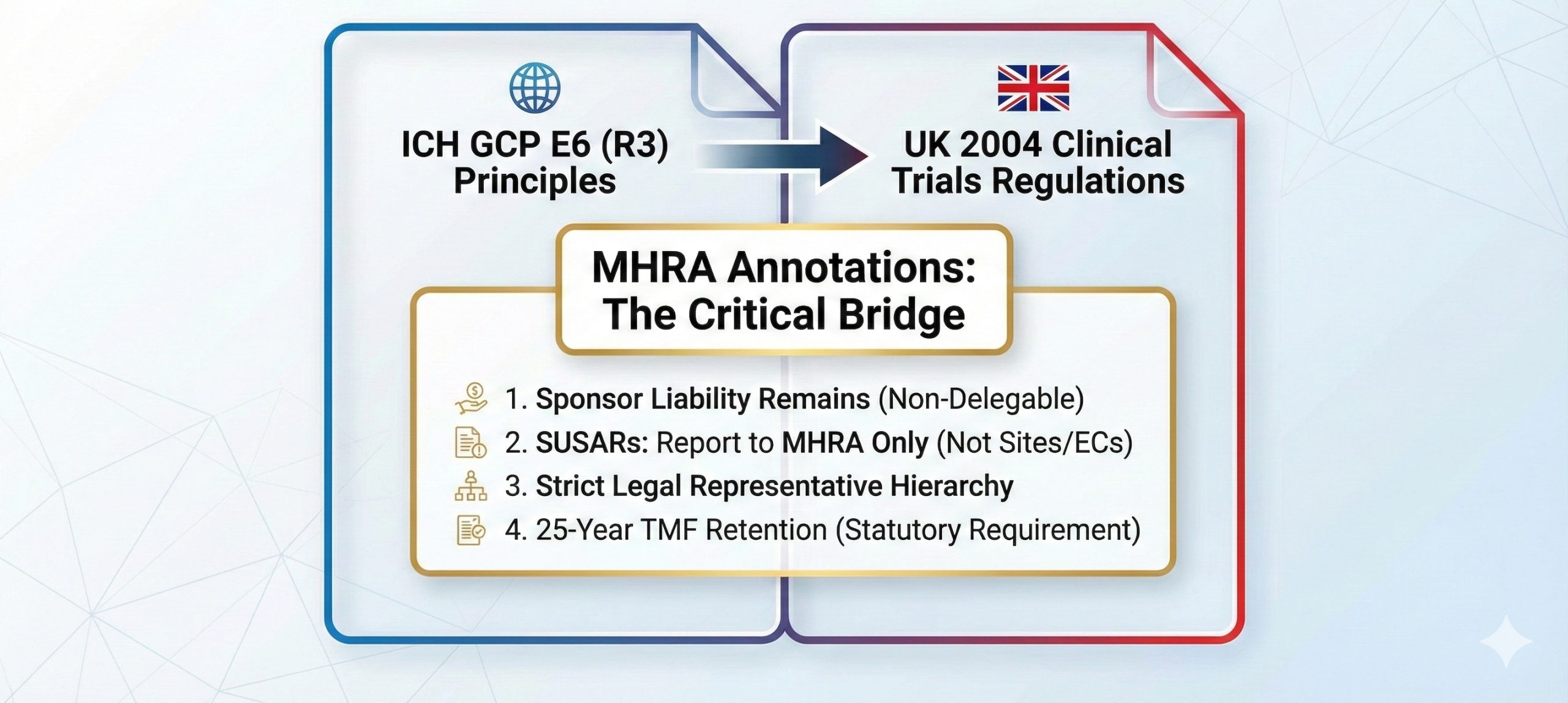
The MHRA has just released its specific annotations for the implementation of ICH GCP E6 (R3). This is a critical document because in the UK, international guidelines (ICH) do not automatically override national law.
For UK sponsors and sites, compliance means navigating the intersection of the 2004 Clinical Trials Regulations and the new R3 Principles.
Here are the 4 biggest practical implications you need to know:
1️⃣ The “Sponsor-Investigator” Responsibility Split
ICH R3 says: Responsibilities can be flexible.
UK Law says: The Sponsor retains ultimate liability. You can delegate tasks to vendors or CROs, but you cannot delegate the legal responsibility. The new annotations clarify that while R3 allows flexibility, UK regulations (Reg 3(12)) prevent you from “washing your hands” of oversight.
2️⃣ Safety Reporting (SUSARs)
ICH R3 says: Report SUSARs to Ethics Committees (IRBs) and Investigators.
UK Law says: 🛑 STOP. There is no legal requirement in the UK to flood investigators or Ethics Committees with individual SUSAR reports. Your obligation is to report to the MHRA. Don’t let R3 training create unnecessary administrative work for your sites.
3️⃣ Consent & “The Representative”
ICH R3 says: Use a “Legally Acceptable Representative” (LAR) for those unable to consent.
UK Law says: The definition of “Legal Representative” is strictly defined in Schedule 1, Part 1. It is not just “next of kin.” The UK specific annotations emphasize that you must follow the specific hierarchy defined in the 2004 Regulations (and the Mental Capacity Act where applicable).
4️⃣ Records & Archiving
ICH R3 says: Retain records based on the “essentiality” of the document.
UK Law says: The Trial Master File (TMF) must be retained for 25 years. The annotations confirm that while R3 introduces new concepts like “media-neutral” records, the statutory retention period in the UK remains explicitly strict under Reg 31A.
🚀 The Takeaway: Don’t just “adopt R3.” Adapt R3 to the UK context. The new MHRA annotations are your bridge between modern global standards and statutory UK law.
Professor at the University of Washington (UW), Seattle, with research and teaching expertise in artificial intelligence, data science, machine learning, and search and recommender systems. A TEDx Speaker and ACM Distinguished Member.
Research focuses on task-based and conversational search and recommendation, user experience, multi-objective optimization, cold-start challenges, and agentic systems. Actively engaged in generative AI research, particularly in information access and image classification, with a strong emphasis on improving fairness and reducing bias in ML/AI systems.
Teaches undergraduate and graduate courses in Information Science and Data Science, and collaborates closely with leading industrial research labs as a visiting researcher. Recent industry engagements include Spotify, Amazon, Microsoft Research AI, Getty Images, and TikTok.
Has worked on real-world problems such as zero-intent and zero-query recommendations, marketplace fairness, and task-, journey-, and mission-based ranking systems, contributing to solutions and products that impact hundreds of millions of users across global markets.
For anyone involved in clinical research, distinguishing between international guidelines and national laws can be a significant challenge. The International Council for Harmonisation (ICH) provides the globally recognized Good Clinical Practice (GCP) guidelines—the “best practice” framework for ethical and scientifically sound research. However, for trials conducted in the United States, these guidelines are the foundation, not the final word. The U.S. Food and Drug Administration (FDA) has its own set of specific, legally-binding rules that every sponsor, investigator, and research site must follow.
While the spirit of ICH GCP and FDA regulations is the same—ensuring data integrity and protecting human subjects—the FDA adds layers of enforceable oversight. Understanding these specific requirements is not optional; it is a prerequisite for compliance. This article distills the most impactful FDA regulations into five critical takeaways that every clinical research professional should know.
Takeaway 1: The Golden Rule – Principles Are Not Laws
1. It’s Not Just a Guideline; It’s the Law.
The most fundamental distinction to grasp is the legal weight behind FDA regulations compared to ICH GCP guidelines. ICH GCP represents a harmonized global standard, a set of principles designed to ensure ethical and scientific quality in clinical trials. In contrast, the FDA’s regulations, found in Title 21 of the Code of Federal Regulations (CFR), are the law in the United States.
This difference is not merely semantic; it has profound practical implications.
ICH = principles; FDA = enforceable law.
While non-adherence to ICH guidelines might harm a study’s credibility, noncompliance with FDA regulations can lead to severe consequences. The FDA has the authority to impose clinical holds, issue fines, reject data submitted for drug approval, and even disqualify investigators from participating in future research.
Takeaway 2: The Starting Gate – The Investigational New Drug (IND) Application
2. You Can’t Start Without the FDA’s Permission Slip: The IND.
Before a single participant can be enrolled in a drug trial in the U.S., the sponsor must submit an Investigational New Drug (IND) application to the FDA, as mandated by 21 CFR Part 312. This application is the official regulatory pathway for testing new drugs in humans and serves as a critical gatekeeping mechanism.
An IND submission is a comprehensive package that must include:
Preclinical data from laboratory and animal studies
Detailed manufacturing information to ensure product quality
The complete clinical protocol for the proposed study
Information on the qualifications of the investigators
Once submitted, the FDA has a 30-day review period. If the agency identifies safety concerns or finds the study design to be scientifically unsound, it can place the trial on a “clinical hold.” This initial review ensures investigational products are evaluated for reasonable safety before human administration. However, the IND is not a one-time permission slip; it is a living application that requires continuous engagement with the agency, including the submission of annual progress reports to maintain its active status.
Takeaway 3: The Guardians of Safety – IRBs and Informed Consent
3. Human Protection is Paramount (and Heavily Regulated).
The FDA places immense emphasis on the protection of human subjects through two complementary regulatory pillars: Institutional Review Boards (IRBs) and the Informed Consent process.
First, under 21 CFR Part 56, every clinical trial must be reviewed and approved by an IRB before it begins. The IRB’s primary function is to protect the rights and welfare of trial participants. To ensure an independent perspective, regulations require diverse membership, including at least one scientist, one non-scientist, and one member unaffiliated with the institution. This oversight is not a single event; IRBs must conduct a continuing review of approved studies at least once a year, ensuring participant protection is an active, ongoing process throughout the trial’s lifecycle.
Second, 21 CFR Part 50 outlines the strict requirements for Informed Consent. This is more than just a signature on a form. The process must ensure that a participant’s agreement is completely voluntary and based on a clear understanding of the study’s purpose, procedures, potential risks, and benefits. The consent form must be written in understandable language, and failure to obtain proper consent can render all data collected from a participant “unacceptable to FDA.”
Takeaway 4: The Digital Paper Trail – Electronic Records Have Rules
4. Your Digital Data Must Be Bulletproof.
In an era where most clinical trial data is captured and stored electronically, 21 CFR Part 11 is a cornerstone of regulatory compliance. This regulation governs the use of electronic records and electronic signatures, ensuring that digital data is as trustworthy and reliable as traditional paper records.
In simple terms, Part 11 mandates that electronic systems used in clinical trials meet core requirements for data integrity:
Validated Systems: The system must be proven to perform accurately and consistently.
Secure Signatures: Electronic signatures must be unique to an individual, secure, and verifiable.
Complete Audit Trails: The system must create a secure, time-stamped record of all data entries and modifications, clearly showing who made a change and when.
These measures are essential for preventing unauthorized access and ensuring the integrity, reliability, and authenticity of the final data submitted to the FDA.
Takeaway 5: The Ticking Clock – Safety Reporting is Urgent and Unforgiving
5. Serious Safety Issues Have a Strict Deadline.
The FDA has explicit and unforgiving timelines for reporting serious safety issues, as detailed in 21 CFR 312.32. This process involves a critical two-step chain of communication. First, investigators are required to immediately inform the sponsor of any serious adverse events. The sponsor then carries the legal obligation to evaluate and report these events to the FDA within strict deadlines.
The key expedited reporting timelines are:
Within 7 calendar days for suspected unexpected serious adverse reactions (SUSARs) that are life-threatening or result in death.
Within 15 calendar days for other serious and unexpected adverse reactions.
These tight deadlines are critical for the FDA’s ongoing safety surveillance. They allow the agency to quickly identify emerging safety signals that may warrant changes to a protocol, updates to the informed consent form, or even a halt to the trial to protect current and future participants from harm.
Conclusion: From Principles to Practice
While ICH GCP provides the essential ethical and scientific framework for global clinical research, the FDA builds upon it with a robust system of legally enforceable oversight. From the mandatory IND application and its annual reporting to the continuous review by IRBs and strict deadlines for safety reporting, these regulations are designed to reinforce scientific validity and, above all, protect the rights and welfare of trial participants. They transform internationally accepted principles into concrete, actionable law.
As clinical research becomes more global and data-driven, how will these foundational U.S. regulations adapt to protect patients while still fostering innovation?
The regulatory environment for medical devices in the United States has undergone a transformative shift following the Food and Drug Administration’s (FDA) release of the final guidance, “Use of Real-World Evidence to Support Regulatory Decision-Making for Medical Devices,” on December 18, 2025.1 This decisive policy update, which supersedes the 2017 framework, fundamentally alters the evidentiary landscape by removing the requirement for sponsors to submit identifiable individual patient data in marketing submissions.2 This singular change dismantles the most significant barrier to the utilization of large-scale Real-World Data (RWD), effectively democratizing access to millions of patient records previously locked behind privacy constraints.
This report provides an exhaustive analysis of the new guidance, dissecting the “Relevance and Reliability” framework that now governs data acceptability. It explores the profound implications for the clinical research ecosystem, predicting a migration from traditional, high-cost Randomized Controlled Trials (RCTs) toward hybrid and pragmatic study designs that leverage synthetic control arms and registry-based evidence. The economic incentives are staggering: early adopters have already demonstrated the ability to reduce time-to-market by 18 months and cut launch research spend by millions of dollars.3
However, this technological and regulatory liberalization exposes a critical “skills gap” in the current clinical research workforce. The industry is currently staffed by professionals trained in the “site-monitoring” paradigm—verifying paper records and managing site compliance. The new paradigm requires a workforce proficient in data curation, epidemiological relevance assessment, and centralized statistical monitoring.
Section 1: The December 2025 Regulatory Pivot
1.1 The Legislative and Regulatory Genesis
To understand the magnitude of the December 2025 guidance, one must contextualize it within the decade-long arc of regulatory modernization initiated by the 21st Century Cures Act of 2016. This legislation mandated that the FDA evaluate the potential use of RWE to support the approval of new indications for approved drugs and to satisfy post-approval study requirements.5
While the 2016 Act provided the mandate, the operational reality was often stifled by conservative interpretations of data quality. The FDA’s initial 2017 guidance established a preliminary framework but left significant ambiguity regarding “data quality,” often leading sponsors to default to traditional RCTs to avoid regulatory risk. The 2017 guidance introduced the concept that RWD must be “fit for purpose,” but failed to provide the granular metrics necessary for sponsors to confidently invest in expensive data acquisition strategies.7
The years between 2017 and 2025 saw a plateau in RWE-based device authorizations. While over 250 premarket authorizations incorporated RWE during this period, the rate of growth slowed as sponsors hit the “identifiability wall”—the FDA’s historical expectation that RWE submissions include private, patient-level data to allow for granular auditing.2 This requirement effectively disqualified the vast majority of “Big Data” sources—claims databases and large de-identified EHR aggregators—which, by design and law (HIPAA), could not provide identifiable records.
The December 15, 2025 announcement and the subsequent final guidance published on December 18, 2025, represent the breaking of this dam. By explicitly stating that the agency “will accept RWE without requiring that identifiable individual patient data… always be submitted,” the FDA has shifted from a stance of “verify every data point” to “validate the data source”.2
1.2 The New Operational Doctrine
The 2025 guidance is not merely a deregulation; it is a restructuring of how scientific evidence is weighed. It applies broadly across the device lifecycle, covering 510(k) clearances, De Novo requests, Premarket Approvals (PMA), and Investigational Device Exemptions (IDE).7
A critical operational change is the “Totality of Evidence” approach. The FDA no longer views RWE as a “lesser” form of evidence to be used only for post-market surveillance. Instead, well-curated RWE can now serve as valid scientific evidence for primary effectiveness endpoints in pre-market submissions. This is particularly relevant for:
Expanded Indications: Using data from off-label use in clinical practice to support a label expansion without a new RCT.10
Synthetic Control Arms: Replacing the active control or placebo arm of a trial with a matched cohort derived from RWD, thereby reducing the sample size and cost of the prospective trial.11
Bridging Studies: Using data from OUS (Outside US) registries to bridge the gap to US medical practice, provided the “Relevance” criteria are met.12
The guidance also clarifies the regulatory status of observational studies. It states that the collection of RWD for a legally marketed device generally does not require an IDE if the device is used in the normal course of medical practice.12 This removes a significant administrative burden for sponsors wishing to conduct retrospective analyses or prospective observational registries, as they no longer need to navigate the complex IDE application process for studies that pose no additional risk to patients beyond standard care.
1.3 Immediate Implementation and Transition
The FDA has signaled a willingness to move fast. While the guidance notes that industry may need up to 60 days to “operationalize” the recommendations, the agency explicitly states it intends to “review any such information if submitted at any time”.7 This implies that ongoing submissions can immediately pivot to incorporate these new flexibilities. For sponsors currently negotiating trial designs with the FDA, this offers an immediate opportunity to propose RWE-based amendments to reduce trial size or duration.
Section 2: Decrypting the “Relevance and Reliability” Framework
The intellectual core of the 2025 guidance is the replacement of the vague “fit-for-purpose” standard with a rigorous, bipartite framework: Relevance and Reliability. Understanding these definitions is paramount for any clinical researcher or regulatory professional, as they constitute the rubric by which all future RWE submissions will be graded.12
2.1 Relevance: The Applicability Test
Relevance asks the fundamental question: Does this data actually answer the specific regulatory question at hand? Even the highest quality data is useless if it does not map to the clinical problem. The FDA breaks Relevance down into key sub-factors:
2.1.1 Data Availability and Granularity
The data must contain sufficient detail to capture the exposure, the outcome, and the covariates.12
Device Identification: This is the most common failure point for RWD. A medical claim might say “Hip Arthroplasty,” but it rarely specifies “Stryker Model X, Lot Y.” The guidance mandates that sponsors assess whether the data source captures the specific device identifier.12 If it does not, the sponsor must demonstrate a method to link the data to another source (e.g., a hospital supply chain database) that does.
Covariates: The data must capture key confounding variables. For a cardiac device, this might include ejection fraction, prior surgeries, and medication history. If the RWD source (e.g., claims data) lacks these clinical details, it may be deemed “Not Relevant” regardless of its size.
2.1.2 Generalizability to the US Population
This is a critical sovereignty check. The guidance requires that RWD be generalizable to the US intended use population.12
The Demographics Test: Sponsors must analyze the demographic breakdown of their RWE source. If a sponsor uses a registry from Japan (where BMI and cardiac risk profiles differ significantly from the US), they must statistically demonstrate that these differences do not invalidate the conclusions for US patients.
Standard of Care: The “background” care in the RWE source must match US clinical practice. If a European registry shows excellent device performance, but European doctors prescribe concomitant medications that US doctors do not, the data may be rejected as irrelevant.
2.1.3 Linkage as a Relevance Enabler
The guidance explicitly endorses “Linkages”.12 The FDA recognizes that no single dataset is perfect. Therefore, the ability to link disparate datasets—for example, linking a Claims Database (for long-term outcomes) with an EHR Database (for clinical granularity) and a Device Registry (for device identification)—is now a primary mechanism for establishing Relevance. This elevates “Tokenization” (the privacy-preserving linking of patient records) to a critical competency in clinical operations.
2.2 Reliability: The Integrity Test
Reliability asks: Is the data accurate, consistent, and trustworthy? The FDA evaluates this through Data Accrual and Data Assurance.10
2.2.1 Data Accrual (The “How”)
This factor scrutinizes the methodology of data collection.
Operational Manuals: Does the registry have a data dictionary? Are the definitions of “Myocardial Infarction” standard across all sites?
Timeliness: The guidance places a premium on “timeliness of data entry”.10 Data entered weeks or months after the event is viewed with skepticism due to recall bias. Automated data capture is preferred.
2.2.2 Data Assurance (The “QC”)
This factor scrutinizes the quality control systems.
Audit Trails: In a major shift, the FDA now expects RWE sources to have audit trails similar to EDC (Electronic Data Capture) systems used in RCTs. Reviewers want to know: Who entered this data? Was it changed? Why?.14
Missing Data: A robust plan for handling missing data is non-negotiable. The guidance notes that real-world data is inherently “messy,” and sponsors must pre-specify how they will impute or handle gaps in the record.15
2.3 The “Device-Generated Data” Opportunity
A significant highlight in the guidance is the treatment of data generated by the device itself.
The Ultimate Reliability: Data recorded by a device (e.g., shock impedance from a defibrillator, glucose values from a CGM) bypasses human entry error. The FDA views this as highly reliable, provided the sensor accuracy is validated.8
Implication: Manufacturers should design future devices with connectivity in mind, specifically to facilitate the automated harvesting of RWD for future regulatory submissions.
Section 3: The Economic and Operational Impact on Clinical Research
The strategic implications of the 2025 guidance extend far beyond regulatory affairs; they fundamentally alter the economics of clinical research.
3.1 The Cost-Benefit Calculus: RCT vs. RWE
The traditional Randomized Controlled Trial is an economic behemoth, often costing between $10 million and $100 million for pivotal device trials. In contrast, RWE studies offer a dramatic reduction in capital expenditure.
Cost Efficiency: Retrospective RWE studies typically cost between $80,000 and $500,000. Even complex prospective RWE studies (registries) rarely exceed $2 million.16 This represents a cost reduction of 90% or more compared to a full RCT.
Resource Allocation: By shifting budget away from site activation and patient stipends (major costs in RCTs) toward data licensing and analytics (major costs in RWE), sponsors can run larger, longer studies for a fraction of the price.
3.2 Accelerating Time-to-Market
Time is the most valuable currency in MedTech. The patent clock is ticking, and competitors are innovating.
Recruitment Velocity: The primary bottleneck in RCTs is patient recruitment, which often takes 12-24 months. In retrospective RWE, “recruitment” is instantaneous—the patients are already in the database.17
Case Evidence: A documented case study involving Premier Inc. and a medical device company demonstrated that leveraging RWD for an expanded indication reduced the time-to-market by 18 months. This 1.5-year head start translates to significant revenue capture and market share dominance.3
Launch Savings: The same case study noted a reduction in launch research spend of $3 million.18
3.3 The Democratization of Evidence
The removal of the identifiable data requirement allows smaller companies to compete. Previously, only large multinationals could afford the infrastructure to manage patient-level privacy for thousands of subjects. Now, a small innovator can purchase a de-identified dataset from a vendor (like Verana or IQVIA) and generate regulatory-grade evidence without a massive clinical operations footprint. This levels the playing field and may spur a wave of innovation from startups that can now afford to prove their claims.
Section 4: The Clinical Research Ecosystem in Transition
The 2025 guidance catalyzes a shift in the operational roles within clinical research. The industry is moving from a “Site-Centric” model to a “Data-Centric” model.
4.1 The Changing Role of the Clinical Research Associate (CRA)
The traditional CRA spends 80% of their time traveling to sites to perform Source Data Verification (SDV)—checking if the data in the EDC matches the patient’s paper chart.
The New Reality: In RWE studies, there is often no “paper chart” to check at a site. The data comes from a centralized EHR extract.
Role Evolution: The CRA role will evolve into a “Clinical Data Auditor.” Instead of visiting sites, they will perform “Centralized Monitoring,” looking for statistical outliers and data integrity patterns across the entire dataset.19 They will focus on “Process Validation” (did the site follow the data entry protocol?) rather than “Data Verification” (is this number correct?).
4.2 The Rise of the “Data Curator”
A new role is emerging: the Clinical Data Curator. This professional sits at the intersection of IT, Clinical Ops, and Regulatory Affairs.
Responsibilities: Their job is to assess the “Relevance” of potential data sources. Can we link this claims database with this registry? Does this EHR extract contain the device identifier?
Skill Set: This requires knowledge of SQL, medical coding (ICD-10, CPT), and regulatory definitions of data quality.14
4.3 The “Synthetic Control” Protocol
Protocol design is shifting. The “Gold Standard” of 1:1 randomization is being challenged by “Hybrid” designs.
Mechanism: A sponsor runs a single-arm prospective trial for the investigational device. They then use RWD to construct a “Synthetic Control Arm” of patients who received the standard of care.
Operational Impact: This makes trials more attractive to patients (everyone gets the new therapy) and easier to recruit. It also reduces the ethical burden of placing patients on a placebo or inferior therapy in life-threatening conditions.20
Section 5: Global Regulatory Harmonization and Divergence
Clinical research is a global enterprise. The FDA’s move has ripples across the Atlantic and Pacific, creating both opportunities for harmonization and risks of divergence.
5.1 FDA vs. ISO 14155:2020
ISO 14155:2020 is the global standard for medical device clinical investigations.
Harmonization: The FDA formally recognizes ISO 14155. The definitions of clinical development stages in ISO 14155 Annex I align closely with the FDA’s lifecycle approach.21
Divergence: While ISO 14155 dictates how to run a study (GCP), it does not dictate what evidence is acceptable. A study can be perfectly compliant with ISO 14155 (reliable) but fail the FDA’s “Relevance” test if the population isn’t generalizable to the US.23 Training must emphasize that ISO compliance is necessary but not sufficient for US approval.
5.2 FDA vs. EU MDR
The European Union Medical Device Regulation (MDR) is currently in a phase of strict enforcement, often demanding high-quality clinical data for legacy devices.
The Contrast: While the FDA is loosening data privacy requirements to encourage RWE, the EU (under GDPR) maintains strict privacy controls. Furthermore, the EU MDR tends to prioritize “Clinical Investigations” (prospective studies) over retrospective RWE for initial conformity assessments of high-risk devices.24
Strategic Split: Sponsors may find themselves able to use RWE for a US submission while being forced to run a prospective study for the exact same indication in Europe. This bifurcation requires sophisticated global regulatory strategies.
Section 6: Case Studies in RWE Success
The theoretical frameworks of the 2025 guidance are validated by real-world successes.
6.1 Edwards Lifesciences: The “Living” Label
Context: Transcatheter Aortic Valve Replacement (TAVR) is a competitive market.
Strategy: Edwards utilized the TVT Registry, a mandated national registry, to capture real-world performance.
Outcome: The FDA used this RWE to approve the SAPIEN 3 valve for “intermediate risk” patients and later for “asymptomatic severe aortic stenosis” (Jan 2, 2026) without requiring massive new RCTs.25
Lesson: Investing in a high-quality registry creates an “asset” that pays dividends for years, allowing for continuous label expansion.
6.2 Medtronic: Bridging Continents
Context: The MiniMed 780G insulin pump system.
Strategy: Medtronic used RWE from Europe (where the device was already approved) to demonstrate the algorithm’s safety during Ramadan (fasting), a scenario difficult to replicate in a US clinical trial.27
Outcome: The FDA accepted this OUS data to support the safety profile, contributing to the system’s approval.
Lesson: “Relevance” can be established across borders if the physiological mechanism (glucose metabolism) is universal, even if cultural practices differ.
6.3 Orchard Therapeutics: The Ethical Necessity
Context:Lenmeldy for Metachromatic Leukodystrophy (MLD), a fatal rare disease.
Strategy: An RCT with a placebo arm was unethical. The sponsor used a “natural history cohort” as the control arm.
Outcome: FDA approval based on the comparison between the single-arm trial and the RWE natural history control.20
Lesson: For rare diseases, RWE is not an alternative; it is the only path. The 2025 guidance codifies the acceptability of this approach.
Section 7: Conclusion and Strategic Outlook
The FDA’s December 2025 guidance is more than a policy update; it is an industrial signal. It signals the end of the “one-size-fits-all” RCT era and the beginning of the “precision evidence” era. By removing the barrier of identifiable data, the FDA has unleashed the potential of millions of patient records to accelerate medical device innovation.
For the industry, the economic benefits are clear: faster time-to-market, lower costs, and continuous lifecycle management. However, these benefits can only be realized by a workforce that is re-skilled for the challenge. The “Site Monitor” of yesterday must become the “Data Auditor” of tomorrow. The “Regulatory Manager” must become an “Evidence Strategist.”
Table 1: Comparative Analysis of Clinical Evidence Pathways (Pre-2025 vs. Post-2025)
Feature
Pre-2025 (Traditional Pathway)
Post-2025 (RWE Pathway)
Strategic Implication
Primary Evidence Source
Randomized Controlled Trial (RCT)
RWE (Registries, EHR, Claims)
Shift from generating data to curating data.
Data Privacy
Explicit Patient Consent (Identifiable)
De-identified / Aggregated / Tokenized 2
Access to millions of records (“Big Data”) becomes feasible.
Control Arm
Placebo or Active Control (Recruited)
Synthetic / Historical Control 11
Reduces patient burden; accelerates timelines.
Cost Model
High CAPEX ($10M – $100M+)
OPEX Driven ($80k – $2M data licensing) 16
Lowers barrier to entry for small innovators.
Time to Evidence
3-7 Years (Recruitment dependent)
Months (Data is already collected)
18-Month Time-to-Market Advantage.4
Regulatory Test
“Fit for Purpose” (Vague)
“Relevance & Reliability” (Specific)
Requires specific training on epidemiological assessment.